Use this blog to post about or look for information on our monthly meetings, jobs, equipment, openings, shows, sales, workshops, classes, residencies, and everything else relating to being a clay artist.
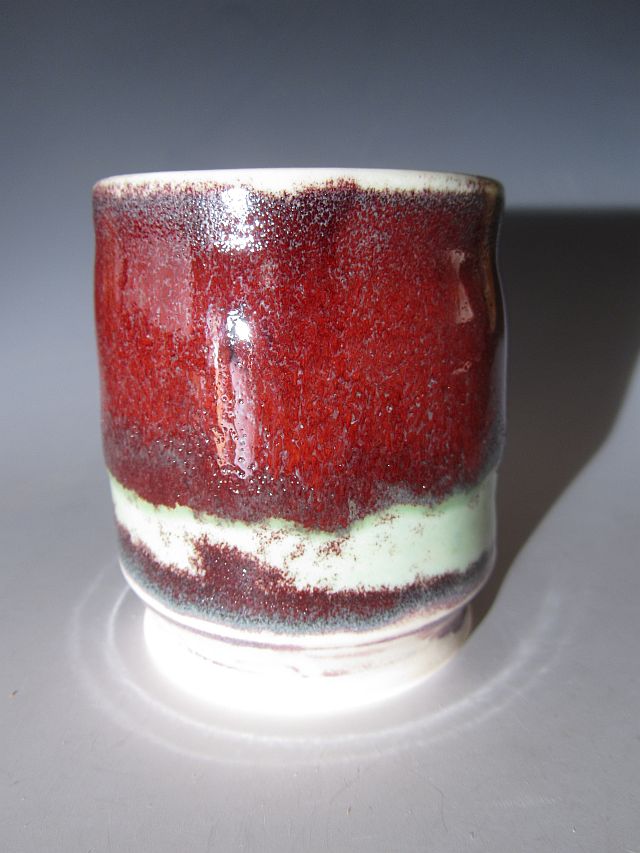
total guess. cone 6 reduction. glaze, i see a light blue around the fringe of the glaze, giving me the thought of a rutile or a chun. but the pin holes tell me it didn't get to total melt and gases didn't escape. but it is a guess.
the pinholes give me the impression of an underfired glaze that the gases escaped and the glaze didn't seal or melt enough to cover. it looks like a small blue line around the red, so my guess for that is from a copper red with rutile, or possibly a chun, cone 6 reduction. but i may hit a whammie.
the pinholes give me the impression of an underfired glaze that the gases escaped and the glaze didn't seal or melt enough to cover. it looks like a small blue line around the red, so my guess for that is from a copper red with rutile, or possibly a chun, cone 6 reduction. but i may hit a whammie.
Nice guesses. One glaze on the outside and it is an electric silicon carbide copper red! On porcelain with a liner that has blue stain. But there are three coats of the one glaze outside. I like the comment about the pinholes! Spot on!
Yes, got to work on it a bit more but I certainly will. If you get some Silicon Carbide from Washington Mills (I think they sell it through Axner or Laguna) just try various copper red recipes at cone 6 with 0.5 % - 1.5% . Get the 600 mesh or more.
I have used silicon carbide grit made for rock polishing in my glazes with good success. If you don't have a lapidary supply nearby, it can easily be ordered off ebay in small amounts. I have seen 400, 500, 600, 3F available. (The finest I have tried is the 500.) In my experiments, I sometimes got pinholes if the silicon carbide got out of hand. Sometimes a refiring smoothed everything out. (But refires sometimes went a darker burgundy color.) A little silicon carbide can create some interesting effects. Paula Lee College, Baytown, TX
Did you ever come up with a recipe on this? It is a beautiful glaze. I wonder if I could come anywhere close to reproducing it. Blues and reds are so striking...
Anonymous said…
I was doing experiments with SiC too, but mine was too coarse, so I got mainly bubbles. Thanks for sharing. Jarmila
I've got your book on mid fire glazes and I had a go at making an artificial red following the Panama Red recipe and adding 0.8% silicon carbide.
The test pieces have come out green with a few teeny tiny purple bits. But 99% green.
I do like the result but have you got any ideas on why it wouldn't have locally reduced to red? I fired using program E2 but a slower ramp up to top temperature.

Comments
In my experiments, I sometimes got pinholes if the silicon carbide got out of hand. Sometimes a refiring smoothed everything out. (But refires sometimes went a darker burgundy color.)
A little silicon carbide can create some interesting effects.
Paula Lee College, Baytown, TX
Thanks Larry
Thanks Larry
I've got your book on mid fire glazes and I had a go at making an artificial red following the Panama Red recipe and adding 0.8% silicon carbide.
The test pieces have come out green with a few teeny tiny purple bits. But 99% green.
I do like the result but have you got any ideas on why it wouldn't have locally reduced to red? I fired using program E2 but a slower ramp up to top temperature.
Thanks!